
Your fleet already produces this data. It just isn't reaching your invoices.
The hours are on the site diary, the servicing is in the mechanic's head, and the compliance dates are in a drawer. This is operations software for a GST- registered hire fleet: built around the work order, the log sheet and the invoice, in the order your business already runs on.
Not a data problem. An agreement problem.
A hire fleet's hard part is rarely any single step: recording hours, raising an invoice, filing it with the government, posting it to the books. It's that every one of those steps has to agree with the one before it, by hand, across however many machines are out on site. Days get worked and never billed. Compliance dates get found out too late. The same figure gets typed three times on its way to the ledger, and each retyping is a place the records can stop agreeing.
One operating cycle, work order to Tally voucher
- Set up the customer and the site once, and the work order carries every machine's own rate, billing unit and operator charge.
- Crews log hours per shift from the meter reading. Hours run is computed, never typed by hand.
- A breakdown blocks billing for that machine automatically, and backfills the gap with a zero-hours entry once it's resolved.
- The invoice drafts itself from the log sheets at the end of the cycle, with GST split by the buyer's state.
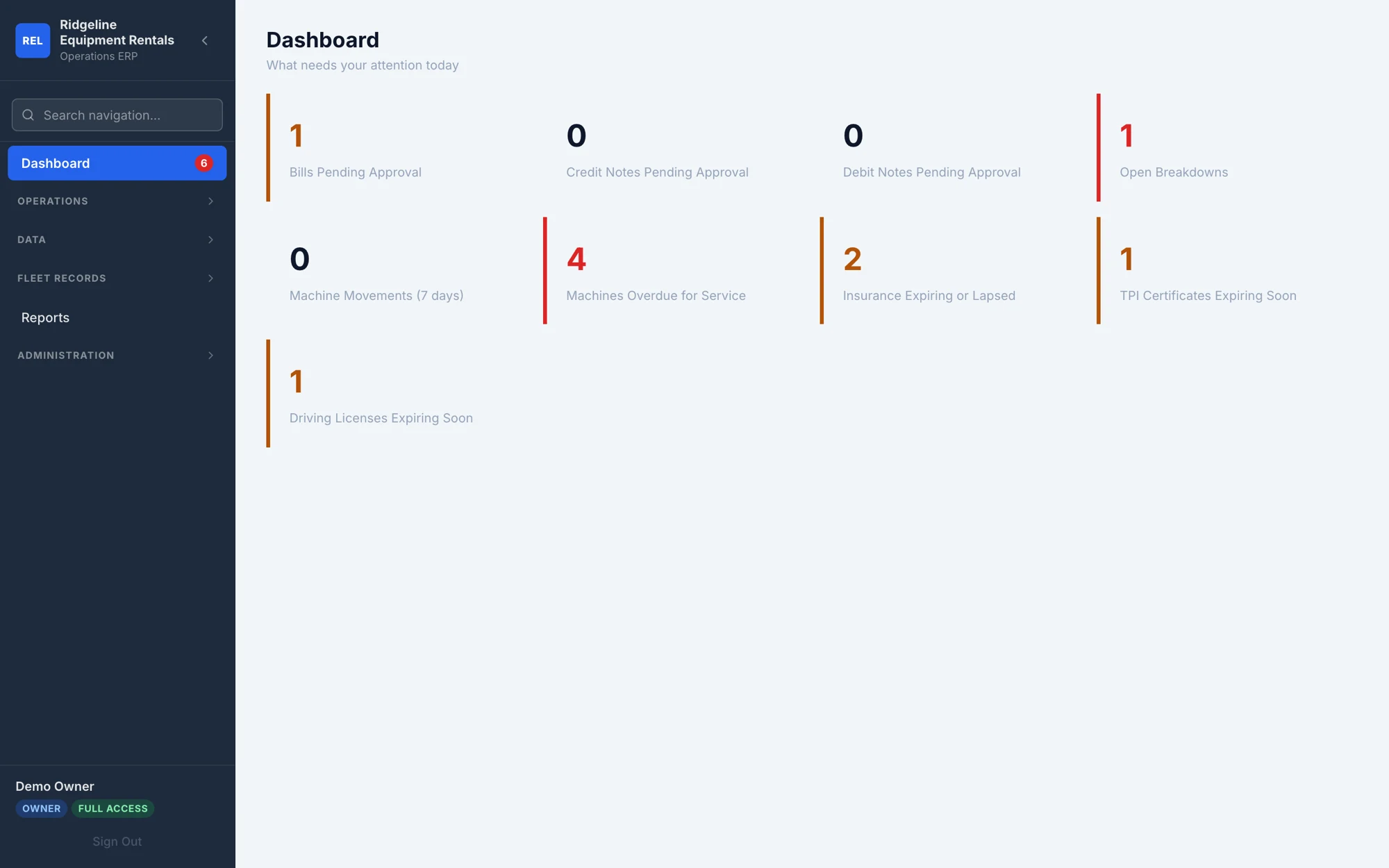
- Only the owner can release an invoice, and once released it's locked against editing.
- The GST e-invoice files with the government portal the moment it's approved, IRN and signed QR code included.
- The voucher posts to Tally automatically, against ledgers already mapped to the real chart of accounts.
- Nothing in that chain runs on a timer. Every step happens because someone in the business asked for it.
Built for a fleet this size
Modelled on a fleet of more than a hundred machines across excavators, cranes, tippers, loaders and lifts, and running in daily production use since August 2026.
- 20
- Modules
- 55
- Screens
- 17
- Reports
- 9
- Dashboard alerts
- 3
- Roles
- 4
- Integrations
The two that sell, and fifteen more behind them
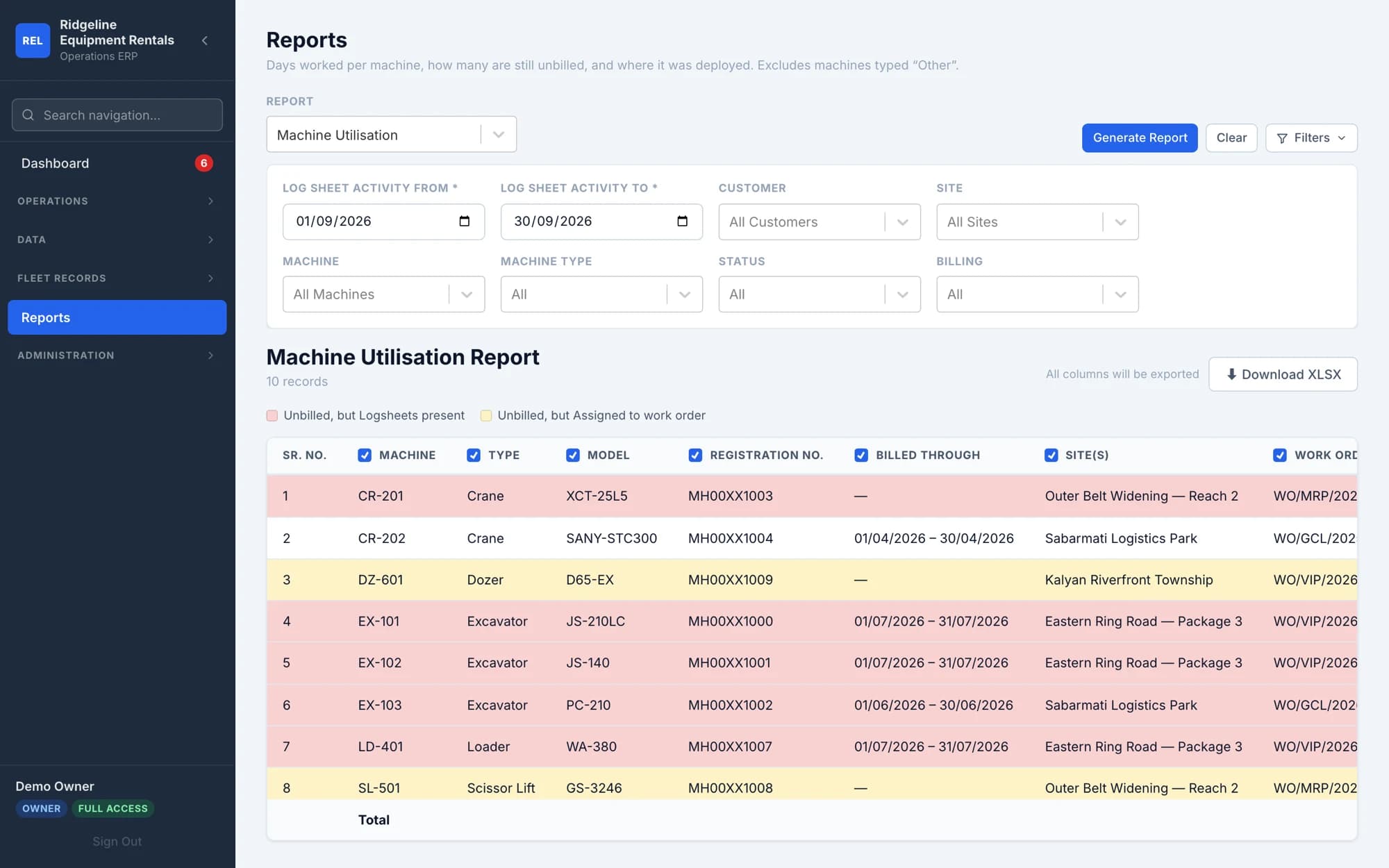
Machine Utilisation is the revenue-leak report: days worked against days billed, with the gap highlighted rather than buried in a total. Machine Log Sheets is the document you put in front of a client who disputes an invoice. The remaining fifteen cover billing, operations, assets, compliance and consumption, and every one exports to Excel with its totals as live formulas.
- Every figure on an invoice traces back to a specific day, a specific machine and a specific meter reading, which is what ends a billing dispute.
- The utilisation report shows exactly which machine-days were worked but never billed, which is where revenue actually leaks.
- Compliance dates (insurance, inspection certificates, operator licences) surface on the dashboard every morning instead of being found out at a client's gate.
Roles, backups and no surprises
Three roles: employee, admin and owner, with only the owner able to release an invoice. Backups run daily by cron. There is no scheduler and no background worker anywhere in this system: nothing reaches the government portal or your books unless someone in your business asked for it.
About this platform
Does this replace Tally, or work alongside it?
Alongside it. The operations system is where the fleet, the log sheets and the invoicing live; approved invoices post into Tally as vouchers with every ledger already mapped, so your accountant keeps working in Tally rather than learning a new system.
How does e-invoicing work exactly?
At the moment an invoice is approved, the system files it with the government's GST e-invoice portal directly. The invoice reference number, the acknowledgement and the signed QR code come back automatically and print on the final invoice, so nothing is retyped into a separate e-invoicing tool.
What happens if a machine breaks down mid-cycle?
Running hours can't be logged for it while the breakdown is open. Once it's resolved, the system backfills every day of the gap with an explicit zero-hours entry, carrying the meter reading forward, so the gap is visible with the repair cost attached rather than silently missing from the record.
More on how we price, host and support everything we build: the full FAQ.
Recognise your own fleet in this?
A 30-minute call is enough for us to tell you whether it's a fit, an adjustment to what you already run, or a problem you shouldn't spend money on yet.